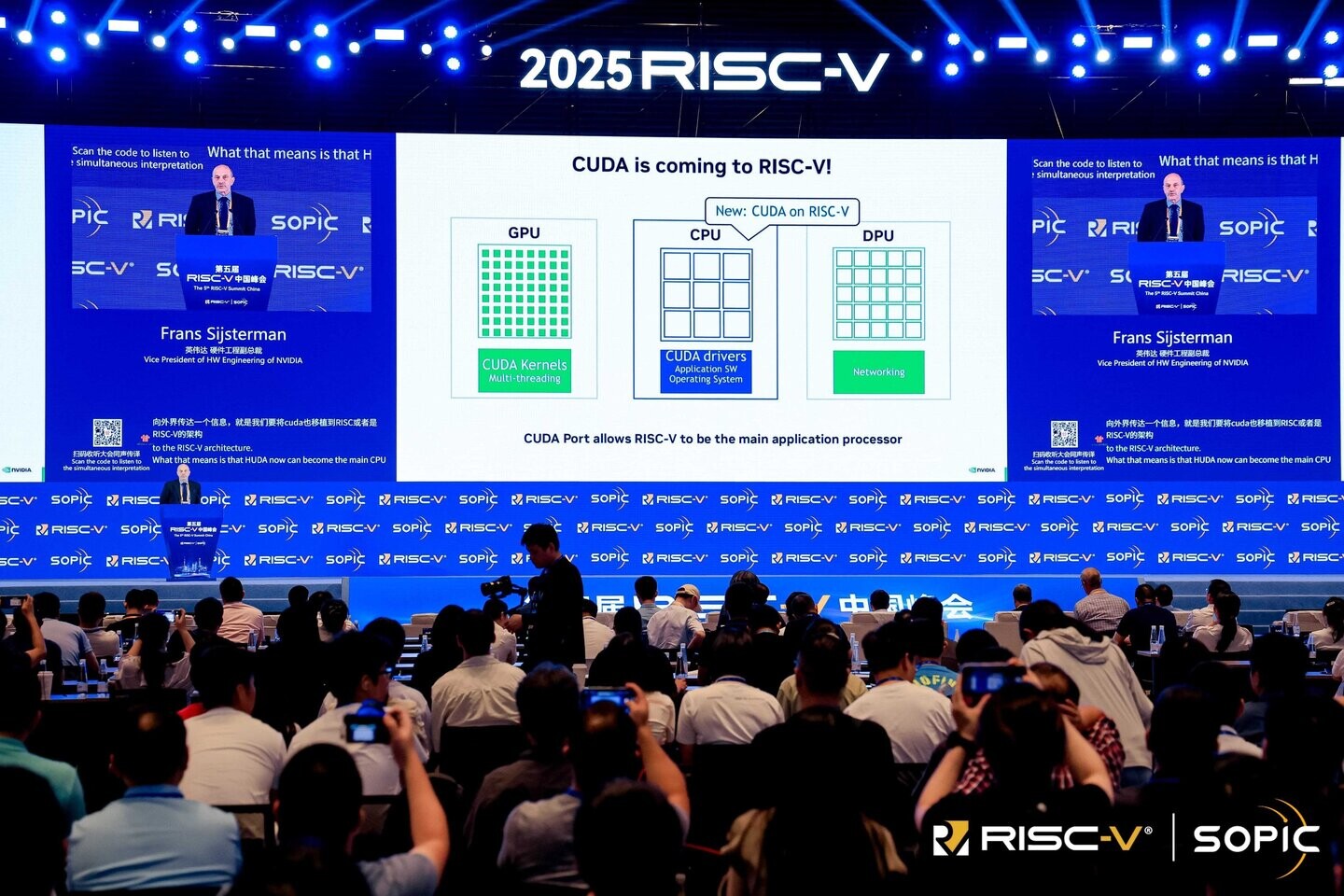
At the RISC-V Summit in China, NVIDIA's Frans Sijstermans, vice president of hardware engineering, officially announced that NVIDIA has successfully transferred its extensive CUDA software library to RISC-V ISA. This indicates that NVIDIA believes RISC-V adoption is increasing across all aspects of the hardware stack and could be a great fit for NVIDIA GPUs. Historically, NVIDIA has adapted its CUDA platform to various major instruction sets such as x86, Arm, PowerPC, and Sun's SPARC to ensure that its GPUs can operate at full speed on any emerging platform. Now, the $4 trillion company is betting on RISC-V becoming the next popular ISA to fully support.
NVIDIA envisions systems where its GPUs play a central role in acceleration, with additional RISC-V CPUs managing CUDA drivers, application logic, and the operating system to handle parallel workloads within the CUDA ecosystem. A diagram presented at the summit illustrates a DPU managing networking tasks, forming a cohesive trio of compute, control, and data movement components. NVIDIA already utilizes NV-RISC-V CPU within its GPUs for control logic, showcasing its strategy of creating heterogeneous platforms that combine RISC-V controllers with GPUs, DPUs, and networking silicon. With CUDA now fully compatible with RISC-V, NVIDIA may explore using the Grace CPU based on the RISC-V ISA.
As the open-source ISA gains traction in the server space with the RVA23 specification, which NVIDIA requires for CUDA support, we may see innovative heterogeneous designs emerge. RISC-V Foundation CEO Andrea Gallo confirmed in an interview that companies are working on server SOC and platform designs that standardize interfaces for peripherals like timers, clocks, IOMMU, RAS, and error reporting mechanisms. This indicates a significant debut of RISC-V CPUs for servers and HPC is on the horizon. It will be interesting to see the developments in the market now that the world's most valuable company is supporting the largest open-source ISA industry movement.