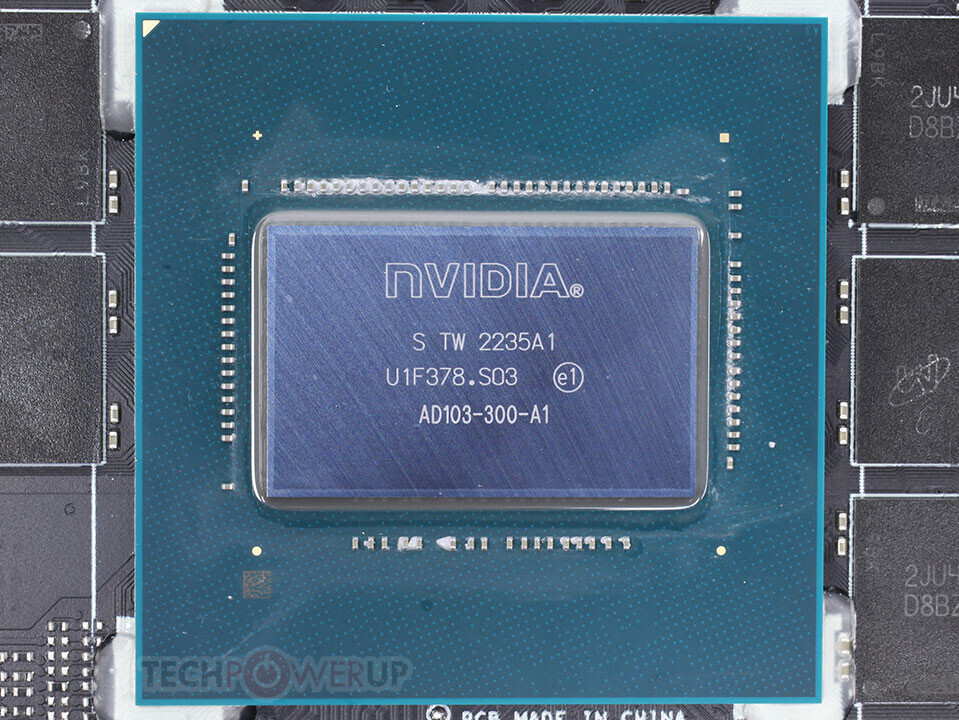
Recent placeholder listings of unreleased MSI RTX 40-series SUPER graphics cards suggest that the RTX 4070 Ti SUPER will feature 16 GB of memory, likely with a 256-bit memory interface. NVIDIA is utilizing the larger "AD103" silicon to create this card, as they have already reached the limit of the "AD104" silicon with the current RTX 4070 Ti. Interestingly, the listings also indicate that the RTX 4080 SUPER will have the same 16 GB of 256-bit memory as the RTX 4080. NVIDIA achieved this by enabling 76 out of 80 SM (38 out of 40 TPCs) in the "AD103" silicon to create the current RTX 4080. It will be intriguing to see if NVIDIA can achieve the performance goals of the RTX 4080 SUPER by simply adding 512 more CUDA cores (from 9,728 to 10,240). NVIDIA has other options at its disposal, such as adjusting GPU clocks, power limits, and memory speeds. The RTX 4080 currently utilizes a memory speed of 22.4 Gbps, which can be increased to 23 Gbps.
The current RTX 4080 has a TGP (Total Graphics Power) of 320 W, while the AD102-based RTX 4090 has a TGP of 450 W. RTX 4080 cards typically come with an NVIDIA-designed adapter that converts three 8-pin PCIe connectors to a 12VHPWR with signal pins denoting a continuous power capability of 450 W. In comparison, RTX 4090 cards include a 600 W capable adapter with four 8-pin inputs. Even with the 450 W capable adapter, NVIDIA has the flexibility to increase the TGP of the RTX 4080 SUPER beyond the 320 W of the older RTX 4080, allowing for higher GPU clocks in addition to maximizing the potential of the "AD103" silicon. NVIDIA is expected to announce the RTX 4070 Ti SUPER and RTX 4080 SUPER on January 8, with the RTX 4080 SUPER becoming available for purchase towards the end of January.